When the case allows it, cardiac surgery can be performed through small incisions — without sawing the sternum. Less trauma, faster recovery, greater safety.
AcademyFirst robotic cardiac surgery training course for residents in Brazil
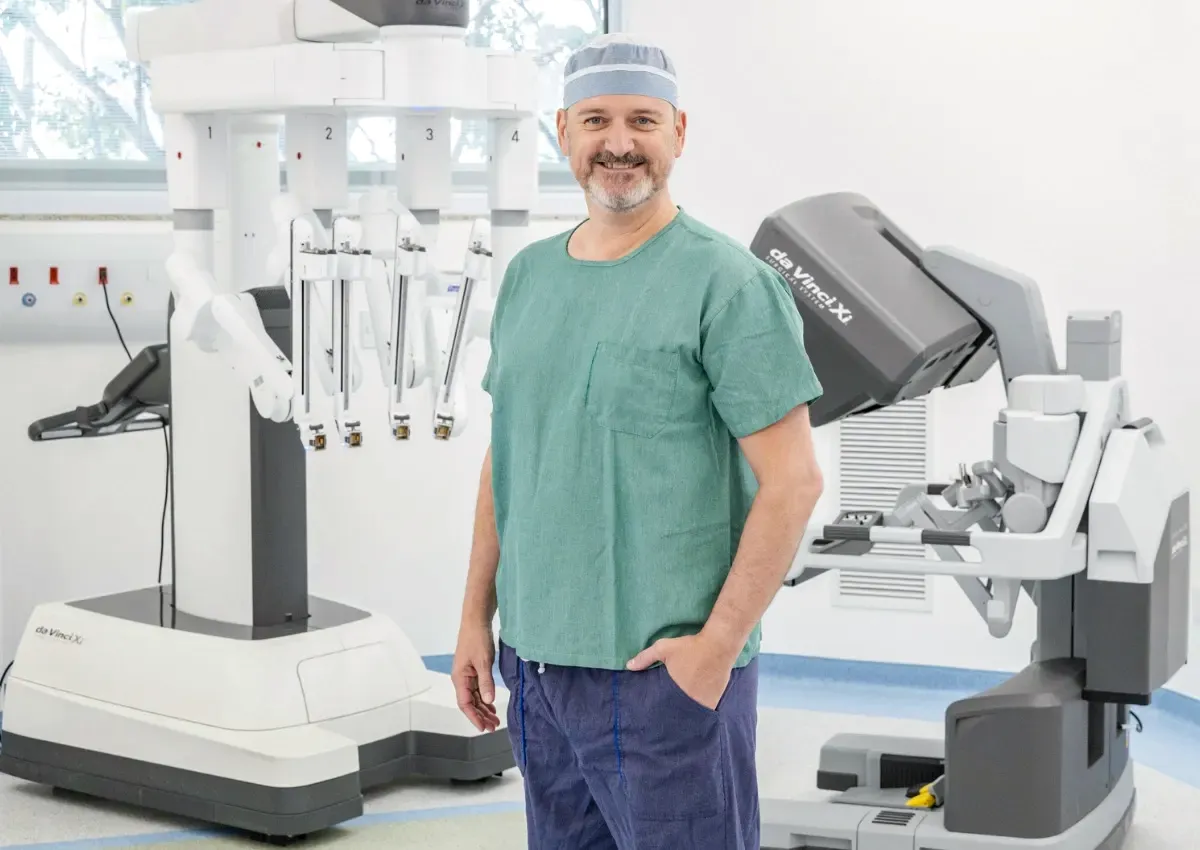
Dr. Robinson Poffo — CRM 133.469
Robotic cardiac surgery tutor at CBC
President DECEM/SBCCV
CRM 133.469São Paulo — SP
Cardiovascular Surgeon
Dr. Robinson Poffo
Specialist in Minimally Invasive and Robotic Cardiac Surgery
Medical degree from PUC Paraná (1992), Residency in Cardiovascular Surgery at Santa Casa de Curitiba, and Master's degree from UFPR (2000). Specialization in Cardiothoracic Surgery at the University of Alabama, USA (1997). In March 2010, he performed the first robotic cardiac surgery in Latin America.
President of the Department of Endovascular and Minimally Invasive Surgery of SBCCV (DECEM); Director of ISMICS (International Society for Minimally Invasive Cardio-Thoracic Surgery); Member of STS (Society of Thoracic Surgeons) and EACTS (European Association for Cardio-Thoracic Surgery); Full Member of the Brazilian Society of Cardiovascular Surgery. Full Member of the Brazilian College of Surgeons.
Director of Instituto Poffo de Cirurgia Cardiovascular in São Paulo; Chief of Cardiac Surgery at Hospital Moriah - SP and Robotic Cardiac Surgeon at Hospital Israelita Albert Einstein - SP.
"My career has always been tied to a greater purpose: transforming the way we care for the heart. Every step was built to bring the most advanced cardiac surgery to our country."
2010
First robotic cardiac case in Latin America
CBC
Robotic cardiac surgery tutor at the Brazilian College of Surgeons.
+30 Years
Dedicated to excellence in cardiac surgery
DECEM
President — Dept. Endovascular & Min. Invasive SBCCV
Clinical Cases
Real outcomes
Every case is unique. These are concrete examples of how minimally invasive and robotic approaches can transform a surgery.
Clinical case
Minimally invasive cardiac surgery
"I was told the only option was to open the chest. That wasn't the only path."
Bruna Honório arrived with a cardiac diagnosis and a prior recommendation for sternotomy. After evaluation, a minimally invasive alternative was identified — without opening the sternum. The result: faster recovery and less surgical trauma.
Surgical case
Robotic resection — Mitral Valve
Ischemic stroke with no apparent cause: benign cardiac tumor detected by echocardiogram
Young patient with ischemic stroke and no clear etiology. Investigation revealed a papillary fibroelastoma attached to the mitral valve — a benign but highly embolic tumor. Robotic resection with valve preservation. ICU discharge 15 hours after the procedure.
Testimonials
What patients say
Voluntary accounts from those who went through the process.
"I had robotic surgery with Dr. Poffo 15 years ago — three days later I was home. It was a mitral valve repair."
P
Patient — robotic mitral repair
"My 65-year-old husband had robotic cardiac surgery with Dr. Sérgio Curcio and had an incredible recovery — discharged in 2 days. Eternal gratitude to the whole team."
F
Patient's family — robotic surgery
"On behalf of our family, we want to thank Dr. Poffo and the entire medical team for the brilliant work they did for my husband. May God bless each one of you."
F
Family member — mitral fibroelastoma
Frequently asked questions
Questions we receive most often
These are real questions from patients and their families.
Not necessarily. The access route — whether the sternum will be opened or not — is determined by what the clinical case requires, not by the surgeon's preference or available technology. In minimally invasive and robotic surgery, the procedure is performed through small incisions without sawing the sternum. Less pain, lower infection risk, and faster recovery. But not every case is a candidate. The indication is made after individual evaluation.
No. In robotic cardiac surgery, the robot is a high-performance tool completely controlled by the surgeon. It replicates hand movements with amplified precision, filters tremors, and offers 3D high-resolution vision. All decision-making, clinical judgment, and technique belong to the surgeon. The robot has no autonomy.
Yes, in well-indicated cases. Without opening the sternum, recovery is typically significantly faster. Patients undergoing robotic mitral valve repair are, in many cases, discharged in 2 to 3 days.
No. Robotic surgery in cardiology has existed for over 20 years with thousands of published studies. In Brazil, there are already over 200 platforms installed. When properly indicated and performed by a certified team, it delivers results comparable or superior to conventional surgery.
The indication depends on each case: the patient's anatomy, the type of procedure required, and general clinical conditions. Assessment is individualized.
Yes. Instituto Poffo performs aortic surgery (including ascending aortic aneurysm), correction of congenital heart defects such as bicuspid valve, heart valve surgery, myocardial revascularization, and other complex cardiovascular procedures.
In sternotomy, the breastbone is opened to access the heart. The bone needs time to heal, imposing more restrictions during recovery. In minimally invasive surgery, access is made through small incisions with high-resolution cameras and specialized instruments, without opening the sternum. Recovery is faster and the physical impact is smaller.
Articles, studies, and editorials published over more than 30 years in cardiovascular surgery.
JTCVS · 2026
Misinformation as a barrier to access to robotic cardiac surgery
Journal of Cardiothoracic Surgery · Dr. Robinson Poffo · 2026
Editorial published in JTCVS addressing how the lack of qualified information prevents patients from benefiting from robotic cardiac surgery — a technology available for over 20 years with more than 200 platforms installed in Brazil.
 Clinical case